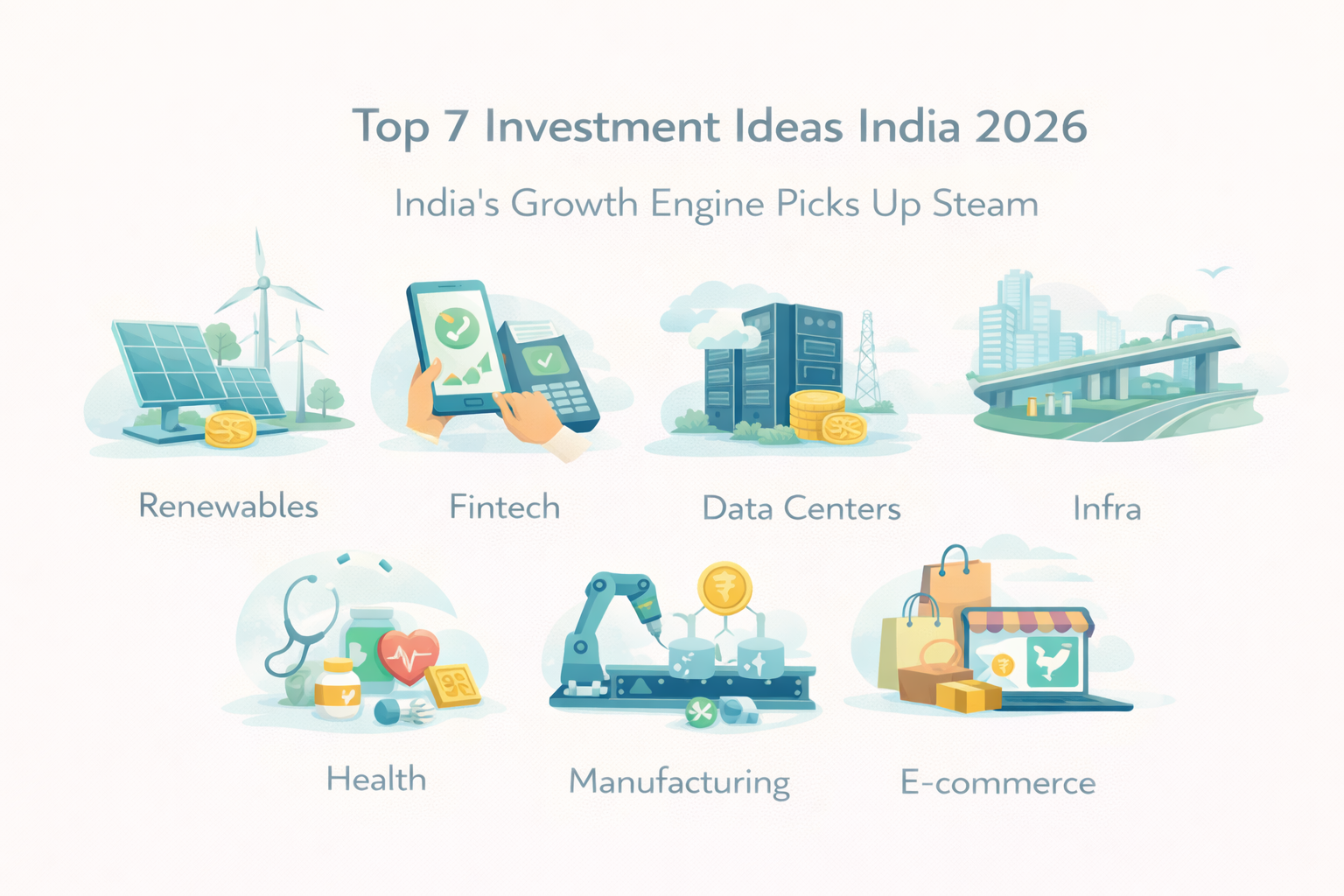
India’s Growth Engine Picks Up Steam
India is heading into 2026 with 7–8% GDP growth expectations, driven by manufacturing incentives, a rapidly digitising economy, and firm green-energy mandates. These shifts are already pulling in $100 billion+ of foreign capital across a few clear pockets.
Renewables added nearly 50 GW of new capacity in 2025 alone, with investments of around ₹2 lakh crore. Digital payments are tracking toward a $10 trillion transaction value, while global cloud and AI players have announced $50 billion+ investments into Indian data-center infrastructure.
Here are seven areas showing real traction via ETFs and mutual funds—no crystal ball, just patterns from recent runs.
1. Renewables: Solar and Wind Capacity Boom
India crossed a key inflection point in 2025, with renewable capacity additions overtaking fossil fuels. Over 22 GW was added in the first half alone, keeping the country on track toward its 500 GW renewable target by 2030. A $360 billion project pipeline and 100% FDI via the auto route continue to support execution.
Players such as NTPC Green and Waaree Renewables reflect the scale building up across generation and manufacturing.
Access via: ICICI Prudential Solar ETF or Tata Ethical Fund (renewables tilt).
These themes have delivered ~22–23% CAGR over three years, though returns will remain cyclical. SIP entry from ₹5,000 helps smooth volatility.
2. Fintech: Digital Payments at $10T Horizon
UPI volumes crossed trillions of transactions in 2025, with industry estimates placing the ecosystem on track for $10 trillion in annual value by 2026, potentially accounting for over 65% of all payments. Merchant transactions are expanding fastest, driven by credit-on-UPI and deeper rural penetration.
Rather than betting on individual apps, exposure through lenders and payment infrastructure providers captures the broader shift.
Access via: Nippon India Financial Services ETF or Kotak Fintech Fund, which track NBFCs and financial platforms benefiting from digital credit expansion.
3. Data Centers: Big Tech’s India Bet
India has emerged as a key destination for cloud and AI infrastructure, with Microsoft and Amazon committing over $50 billion combined. Falling power costs, renewable integration, and demand from Global Capability Centers are driving both capacity build-out and commercial real estate absorption.
Access via: Motilal Oswal Data Center–linked InvITs or diversified infrastructure funds such as HDFC Infrastructure Fund.
This theme blends yield visibility with long-term growth, rather than pure momentum.
4. Manufacturing: PLI Schemes Scale Up
By 2025, nearly ₹1.97 lakh crore had been disbursed under PLI schemes across electronics, chemicals, and manufacturing, with exports in several segments doubling to $100 billion+. The focus has shifted from announcement to execution.
Auto, electronics, and component manufacturers—especially those aligned with EV and export demand—stand to benefit as scale improves.
Access via: Nifty India Manufacturing ETF, offering diversified exposure without single-stock risk.
5. Infrastructure: InvITs for Steady Yield
Infrastructure Investment Trusts (InvITs) have become a preferred route for funding roads, power transmission, and highways. Yields in the 8–10% range provide income visibility, supported by long-term concessions and government-backed cash flows.
Access via: IRB InvIT Fund or IndiGrid InvIT, which focus on operating assets rather than development risk.
6. Healthcare: Post-Pandemic Demand Holds
Healthcare demand remains structurally strong even after the pandemic surge. Ayushman Bharat expansion, rising insurance coverage, and steady pharma exports (up around 10%) continue to support earnings visibility.
Access via: Mirae Asset Healthcare ETF, tracking large pharmaceutical and healthcare companies such as Sun Pharma and Dr Reddy’s.
7. E-Commerce/Consumption: Urban Spend Surge
India’s consumption story is increasingly driven by Tier-2 and Tier-3 cities. Platforms such as JioMart and Flipkart are pushing overall GMV toward $200 billion+, supported by logistics, payments, and private-label expansion.
Access via: Nippon India Consumption ETF, offering exposure to organised retail, food delivery, and consumer staples leaders.
How to Play These Without Overthinking
Thematic ETFs and mutual funds allow investors to participate with small allocations instead of concentrated bets. A starter tilt could look like 20% renewables, 15% fintech, with the rest in core equity funds.
Over the last three years, several of these themes delivered 20%+ CAGR during India’s equity recovery—but they remain cyclical. Annual rebalancing matters more than timing. Policy tailwinds such as PLI incentives and green-hydrogen mandates add support, but outcomes still depend on holding period and risk tolerance.
These themes show momentum—but only make sense if they fit your runway. Short-term goals may not suit infrastructure or manufacturing cycles. Eyeing one sector for 2026? Drop it below.
For questions, collaborations, or deeper guidance, write to us at info@nomisma.club.
Disclaimer: This article is for educational purposes and not financial advice.
Leave a Reply