
Author: Nomisma Editor

  • Gold & Silver Post-Budget Dip: Buy the Bottom or Wait for More Correction?

    Gold & Silver Post-Budget Dip: Buy the Bottom or Wait for More Correction?

    Gold & Silver Post-Budget Dip: Buy the Bottom or Wait for More Correction?

    TL;DR for Confused Investors (Read This First)

    If you don’t own much gold yet:
    → Start small. Use SIPs in Gold ETFs over the next few months instead of buying all at once.

    If you already hold a lot of gold (jewellery + SGBs):
    → Don’t rush to add more. This dip doesn’t demand urgent action.

    If you’re considering Sovereign Gold Bonds (SGBs):
    → Prefer fresh government issues. Avoid buying old SGBs from the market at a premium.

    If you like higher risk and volatility:
    → Silver can move faster than gold—but limit exposure and use ETFs only.

    Bottom line:
    Gold still works as a hedge, not a shortcut. Think 5–10% of your portfolio, not an all-in bet.

    Explaining the dip

    Gold and silver prices in India fell 6–9% within days of Budget 2026, with MCX gold sliding from near ₹98,000 per 10g to around ₹89,000–91,000, and silver dropping from ₹1.25 lakh per kg levels.

    This wasn’t because gold suddenly became a “bad asset.” The fall came from a mix of policy tweaks, global cues, and investors locking in profits after a very strong 2025. For retail investors, this creates a familiar dilemma: buy the dip now, or wait for more correction?

    Here’s what actually changed—and how to think about your next move.

    What Triggered the Sharp Correction?

    Three things came together right after the Budget speech on February 1:

    1. Customs Duty Cut (Smaller Than It Sounds)

    Customs duty on gold and silver dor bars was trimmed to 5% from 6%.
    In reality, this doesn’t dramatically lower jewellery prices because GST and making charges still make up most of the final cost.

    What it did do was give traders a reason to sell and lock in profits after gold’s 70%+ rally in 2025, accelerating the fall.

    2. Sovereign Gold Bond (SGB) tax change — the biggest trigger

    This is the most important shift to understand.

    Earlier, investors could buy old SGBs from the stock market and still enjoy tax-free gains at maturity, even if they were not the original buyers. Many people did this purely to save tax, which pushed SGB prices 10–15% above gold prices.

    From April 1, 2026, this tax-free benefit will apply only to original SGB subscribers, not to people buying them later from the market.

    As a result:

    • Investors holding expensive SGBs rushed to sell
    • Premiums started shrinking
    • Sentiment spilled over into gold ETFs and spot prices

    3. Global Pressure Added Fuel

    Globally, gold and silver also fell 4–6% as:

    • The US Federal Reserve signalled rate cuts may come later
    • The dollar strengthened
    • Global investors reduced “safe haven” positions

    When global prices fall, Indian prices usually fall more because we import most of our gold—even if the rupee is relatively stable.

    Quick Reality Check: How Big Was the Fall?

    MetalPre-Budget PeakPost-Dip Low% DropCurrent (Feb 9)
    Gold (₹/10g)~₹98,500~₹89,200~9%~₹91,800
    Silver (₹/kg)~₹1.25 lakh~₹1.12 lakh~10%~₹1.18 lakh

    Context matters:
    After a steep run-up, such pullbacks are normal. Prices often stabilise around zones where buyers historically step in. For gold, that zone has been around ₹92,000–93,000, which explains why the fall slowed there.

    Silver tends to swing more because part of its demand comes from industries like solar panels and electronics, not just investment demand.

    Tax Changes Explained in Simple Terms

    Sovereign Gold Bonds (SGBs)

    • Original buyers: No change. Gains at maturity remain tax-free.
    • Secondary market buyers: Tax-free benefit ends after April 2026.
    • Expect 5–10% premium compression in SGB prices over time.

    Gold ETFs and Digital Gold

    • No rule change.
    • Long-term gains (after 1 year): 12.5% tax on gains above ₹1.25 lakh.
    • Example:
      If you make ₹2 lakh profit, only ₹75,000 is taxed.

    Physical Gold

    • Short-term sale: taxed at your income slab.
    • Long-term (3+ years): 12.5% LTCG.

    Customs Duty Cut

    • Saves about ₹600 per 10 grams at the raw import level.
    • Most of this does not reach consumers due to GST and making charges.

    Buy Now, Average Down, or Wait?

    When buying the dip makes sense

    • You want gold as a rupee hedge and safety buffer
    • You currently have less than 5% exposure
    • You are buying via ETFs or fresh SGB issues, not overpriced physical gold
    • You understand that gold is protection, not a growth engine
    • You understand silver can swing 20–30% easily

    When waiting makes sense

    • You already hold a lot of gold (especially jewellery)
    • You recently bought SGBs from the market at a premium
    • You’re uncomfortable with short-term volatility
    • You prefer clarity over catching the exact bottom

    A practical middle ground

    For most Indian retail investors, the sweet spot remains:

    • 5–10% total allocation to gold and silver
    • Prefer Gold ETFs or primary SGBs
    • Use monthly SIPs instead of lump sums
    • Treat jewellery as consumption, not investment

    Silver can be added via ETFs if you are comfortable with sharper price swings, but keep exposure smaller than gold.

    Action Steps You Can Take This Week

    1. Check your exposure
      If gold + silver already exceed 15% of your total portfolio, avoid adding more.
    2. Restart or begin SIPs
      ₹5,000 per month into a Gold ETF reduces timing risk and regret.
    3. Avoid emotional buying
      Jewellery purchases should be driven by life events, not market dips.

    Bottom Line

    The Budget clarified tax rules and removed a pricing distortion, but it did not break gold’s role in a portfolio. Gold still works best as insurance, not a moonshot.

    Position for volatility, stay disciplined on allocation, and let time do the heavy lifting.

    What’s your gold exposure right now—adding, holding, or waiting?

    For questions, collaborations, or deeper guidance, write to us at info@nomisma.club.

    Disclaimer: This article is for educational purposes and not financial advice.
  • Last‑Minute Tax Saving Checklist Before 31 March (Sections 80C, 80D, 80CCD)

    Last‑Minute Tax Saving Checklist Before 31 March (Sections 80C, 80D, 80CCD)

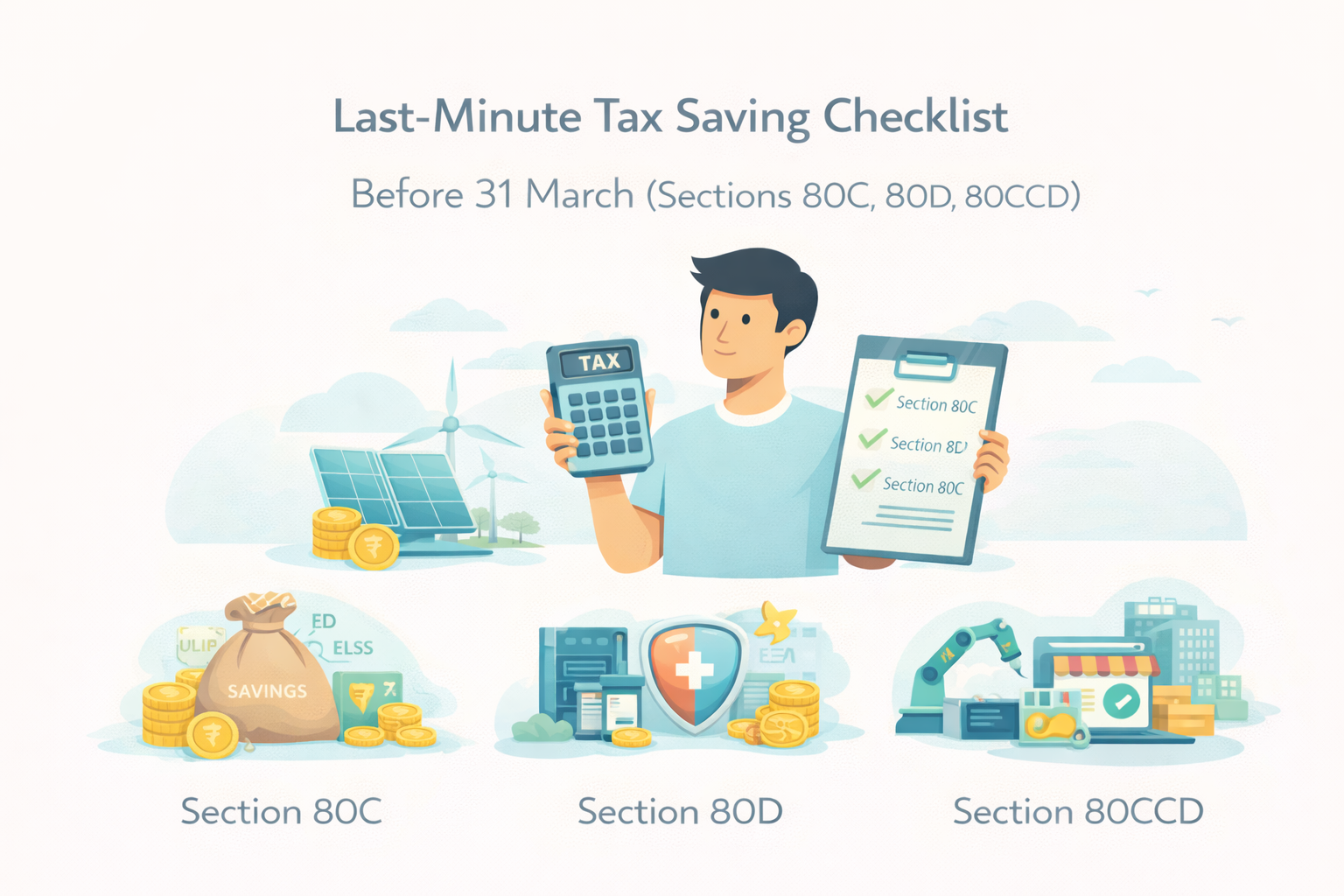
    A last‑minute tax saving checklist works best when it tells you exactly which section to use, how much room is left, and where to park the next ₹10,000–₹50,000. This guide is for FY 2025‑26 (AY 2026‑27) under the old regime, where deductions matter most.​ Use this as a checklist, not a shopping list.

    Step 1: Check if the Old Regime Even Makes Sense

    Before chasing deductions, see whether the old regime actually beats the new one for your income and deductions.​

    • Old regime: higher slab rates but allows most deductions (80C, 80D, 80CCD, HRA, home loan interest under Section 24, etc.).​
    • New regime: lower slab rates, standard deduction, very limited deductions; suits people with few investments or benefits.​

    Use an ;old vs new regime’ calculator, plug in your expected 80C, 80D, 80CCD, and home‑loan claims; if the old regime shows lower total tax, this checklist is worth acting on.​

    Step 2: Maximise Section 80C (Limit ₹1,50,000)

    The combined limit for the most common deductions here is ₹1,50,000.​

    Covered instruments include:

    • Employee Provident Fund (EPF) and Voluntary PF
    • Public Provident Fund (PPF)
    • Equity‑Linked Savings Schemes (ELSS mutual funds)
    • 5‑year tax‑saving bank fixed deposits
    • Life insurance premiums (including term plans)
    • Principal repayment of a home loan, tuition fees for up to two children​

    If you have ₹20,000–₹50,000 left under 80C:

    • Up to ₹20,000 remaining, and you are comfortable with markets:
      • Consider a lump sum into an ELSS fund or start a short series of monthly systematic investment plans before 31 March. Lock‑in is 3 years, and gains are taxed as long‑term capital gains.​ Expect short-term volatility; this suits money you won’t need for 3+ years.
    • Around ₹50,000 remaining and you want safety:
      • Top up your PPF if you already have an account (15‑year tenure, interest is tax‑free, and contributions count under 80C).​
      • Alternatively, use a 5‑year tax‑saving fixed deposit with a scheduled bank; interest is taxable, but the principal qualifies under 80C.​
    • If you have not bought term insurance yet:
      • A pure term life policy premium also counts under 80C and simultaneously fixes a protection gap, which is often more important than squeezing another investment in.​

    Step 3: Use Section 80D for Health Insurance

    Section 80D is specifically for medical insurance premiums and preventive health check‑ups.​

    Key limits for FY 2025‑26:

    • Self, spouse, and dependent children: deduction up to ₹25,000 on health insurance premiums.
    • Parents: additional up to ₹25,000 if they are below 60 years, or up to ₹50,000 if they are senior citizens (60 years or more).​

    What to do if you have remaining room under 80D:

    • No health cover for parents, and you can spare ₹15,000–₹30,000, this year:
      • Consider a family floater or senior citizen plan for them; this can both protect savings and reduce taxable income.​
    • Already have insurance but have not claimed a preventive health check‑up:
      • A part of the 80D limit can be used for preventive check‑ups (within the overall cap), so a scheduled check‑up before 31 March can legitimately increase your claim.​

    Step 4: Add NPS on Top – Section 80CCD

    The National Pension System has its own deduction structure and can sit on top of 80C.​

    There are three relevant parts:

    • Section 80CCD(1): your own contribution, counted within the ₹1,50,000 limit of Section 80C (subject to 10% of salary for salaried employees).​
    • Section 80CCD(1B): an additional, exclusive deduction of up to ₹50,000 for your own NPS contribution, over and above the 80C limit.​
    • Section 80CCD(2): employer’s contribution to NPS (up to 10 percent of salary for private sector employees) is deductible for you and does not eat into the 80C limit.​

    If you still have room and time:

    • If your 80C bucket is already full and you have another ₹20,000–₹50,000 to invest:
      • A voluntary contribution to NPS Tier I to use the additional ₹50,000 limit under Section 80CCD(1B) is one of the clearest ways to reduce tax, plus earmark money for retirement.​
    • If your employer offers NPS and you are underusing it:
      • You can discuss redirecting part of your cost‑to‑company into NPS so that Section 80CCD(2) benefits apply from the next financial year onwards. This is not a “last‑minute” step but is worth mentioning in a March‑time review.​

    Remember that NPS is a long‑term product; partial withdrawal and exit rules are stricter than those of mutual funds or PPF, so it suits people who are consciously building a retirement pool.​

    Step 5: Sequence if You Have Limited Surplus

    If you are deciding where to allocate the next block of money before 31 March, a simple sequence many planners use under the old regime is:​

    1. Close the 80C gap with instruments that match your risk and time horizon
      • Growth‑oriented: ELSS mutual funds.
      • Stability‑oriented: PPF or tax‑saving fixed deposits.
    2. Use 80D to fix any health insurance gaps for self and parents.
    3. Add NPS for an extra ₹50,000 deduction under Section 80CCD(1B) if you can genuinely lock this money away for retirement.

    This way, each rupee just before year‑end either reduces tax, adds protection, or builds long‑term wealth rather than sitting idle in a low‑yield savings account.

    For questions, collaborations, or deeper guidance, write to us at info@nomisma.club.

    Disclaimer: This article is for educational purposes and not financial advice.

  • Best Credit Cards in India for 2026: Top 10 for Cashback, Rewards & Travel

    Best Credit Cards in India for 2026: Top 10 for Cashback, Rewards & Travel

    Best Credit Cards in India for 2026

    Below is a practical, income-band-based look at popular SBI, HDFC, Axis, and IndusInd cards in early 2026. This guide focuses on widely available cards you can realistically apply for in 2026. Card features and fee waivers change frequently, so treat this as a starting shortlist, not a final checklist. 

    How to read this guide

    • Focus on four things: real reward/cashback rate, annual fee vs waiver threshold, lounge access, and how much you actually spend.
    • Income bands here are rough issuer guidelines, not guarantees: banks also look at credit score and existing debt.​

    Top 10 cards (by type, not rank)

    1. SBI Cashback Credit Card – Simple 5% Cashback

    • Type: Cashback, low‑fee.
    • Key perks: Flat 5% cashback on most online spends (monthly cap applies), 1% on offline; basic fuel surcharge waiver.​
    • Fee: Typically ₹999 + GST, often waived on hitting annual spend thresholds (check current offer).​
    • Good for: People doing the bulk of their shopping on Amazon, Myntra, Swiggy, Zomato, etc., and who don’t care about miles excluding some wallet loads / utilities.

    2. SBI SimplyCLICK – Entry‑Level Online Spender Card

    • Type: Online shopping rewards.
    • Key perks: Extra rewards on Amazon/BookMyShow and partner sites; joining gift vouchers; frequent discount tie‑ups.​
    • Fee: Low (around ₹499), usually waived at modest annual spend.​
    • Good for: First card at ₹3–5L income level, building history while getting decent partner offers.​

    3. HDFC Regalia/Regalia Gold – All‑Rounder Premium

    • Type: Rewards + travel.
    • Key perks: Around 1.5–2% effective reward rate via points; domestic lounge access; dining and hotel offers; good SmartBuy multipliers.​
    • Fee: Mid‑range; frequently waived at ~₹3–4L annual spends.​
    • Good for: Salaried professionals in the ₹10–15L range who travel 3–6 times a year and want one “do‑it‑all” card. SmartBuy multipliers (on select partners)

    4. HDFC Diners Club Black (and Metal) – High‑Spender Travel Beast

    • Type: Super‑premium travel/rewards.
    • Key perks: Unlimited global lounge access for primary + add‑on, 3.3% base rewards, 10X points on partner spends, premium memberships bundled.​
    • Fee: High (₹10k+), justified only if you spend ₹8-10L+ per year.​ Acceptance can be limited in some offline locations.
    • Good for: 20L+ income, heavy travellers who can make use of lounges, golf, hotel, and airline transfer partners.​

    5. Axis Bank ACE (or similar Axis cashback variants)

    • Type: Cashback.
    • Key perks: Elevated cashback on bill payments and DTH/mobile recharges via partner apps, plus decent rewards elsewhere.​
    • Fee: Low; often waived first year or on modest spend.​
    • Good for: UPI + bill‑pay heavy users who want simple statement credits instead of complex points.​

    6. Axis Bank Atlas / Horizon – Miles and Travel

    • Type: Travel miles.
    • Key perks (Atlas/Horizon family): Earn EDGE Miles, multiple domestic/international lounge visits, partner transfer to airlines/hotel programs; dining discounts.​
    • Fee: Mid to high (a few thousand), worthwhile only if you actually redeem flights/hotels.​
    • Good for: 10–20L income frequent flyers who prefer miles over flat cashback.​

    7. Axis Bank Magnus (super‑premium, but notable)

    • Type: Luxury travel.
    • Key perks: Very strong lounge access, milestone flight vouchers, concierge, and lifestyle perks.​
    • Fee: High (₹10k+); targeted at high‑net‑worth individuals with big annual spends.​
    • Good for: 25L+ income, serious travellers who optimise every rupee of travel spend.​

    8. IndusInd Platinum / Legend – Flexible Rewards

    • Type: Rewards all‑rounder.
    • Key perks: Decent points on daily spends, partner dining and entertainment offers; often, lifetime‑free (LTF) variants run as promos.​
    • Fee: Varies; some versions sold with a one‑time joining fee and no annual fee afterwards.​
    • Good for: Those wanting an IndusInd relationship and occasional offers, without chasing extreme optimisation.

    9. IndusInd Avios Visa Infinite – Airmiles Specialist

    • Type: Airmiles.
    • Key perks: Up to 6 Avios per ₹200, sizeable milestone bonuses, good for British Airways/Iberia/partner flyers; premium Visa Infinite benefits.​
    • Fee: High joining/renewal; niche use case.​
    • Good for: People who already fly Avios partner airlines and understand airmiles ecosystems.

    10. “Lifetime‑Free” and Low‑Income Options

    • Examples: IDFC First Millennia, some SBI/Axis/ICICI LTF campaigns.​
    • Key perks: No annual fee, fair reward rates, sometimes lounge access via offers; easier approval at ₹25k–50k monthly income.​
    • Good for: First‑timers and those who want to build credit without worrying about fee recovery.

    Which card should you choose if you earn ₹5L, ₹10L, ₹15L, or ₹20L+?

    Think of this as a starting framework, not a prescription.​

    Around ₹5 lakh income section (≈₹40k/month)

    • Priorities: Build credit history, keep fees low, get basic rewards.
    • Typical picks:
      • SBI SimplyCLICK or SBI Cashback (if your spending is mostly online).​
      • An LTF card, like an IDFC Millennia or equivalent entry‑level card.​
    • Why: Easier approval bands, low or waived fees, and still decent returns on groceries, fuel, and online shopping.​

    Around ₹10 lakh annual income

    • Priorities: Better rewards, some lounge access for 2–4 trips a year. Approval still depends on credit score and existing EMIs.
    • Typical picks:
      • HDFC Regalia / Regalia Gold as a “main” card.​
      • SBI Cashback or Axis ACE as a secondary card for bill‑pay/online cashback.​
    • Why: You’re likely to cross annual spend thresholds to offset fees, and lounge access starts to matter for occasional travel.​

    Around ₹15 lakh annual income

    • Priorities: Higher limits, mix of rewards and travel, better dining/partner offers.
    • Typical picks:
      • Regalia Gold or an Axis Atlas‑type travel card (if you fly more).​
      • One solid cashback card (SBI Cashback / Axis ACE) to cover non‑travel spends.​
    • Why: At this income, you can make use of both miles and cashback stacks; you also stand a better chance at premium approvals.​

    ₹20 lakh+ annual income

    • Priorities: Premium lounge access, airmiles, high reward rates on large spends.
    • Typical picks:
      • HDFC Diners Club Black / Infinia, Axis Magnus, or high‑end travel cards (subject to bank invite or internal eligibility criteria).​
      • A simple 5% cashback card (SBI Cashback) for everyday online spends that don’t maximise miles.​
    • Why: Fees of ₹10k+ can be justified when you’re spending 8–10L+ annually and using lounge, hotel, and airline benefits regularly.​

    A few practical guardrails

    • One main card + one backup is usually enough; more cards mainly add complexity unless you enjoy optimisation.​
    • Always check: joining fee, annual fee, and exact spend needed for fee waiver; these change often, so read issuer or aggregator fine print before applying.​
    • Perks like lounge access sound great, but matter only if you actually travel; cashback can be more “real” for a homebody salary earner.​

    Use this guide as a first filter; you can then check detailed comparisons and current offers on aggregators like Paisabazaar, BankBazaar, or Fi Money before you click “apply”.​

    For questions, collaborations, or deeper guidance, write to us at info@nomisma.club.

    Disclaimer: This article is for educational purposes and not financial advice.

  • Top 7 Investment Ideas India 2026: Renewables, Fintech, Data Centers, Infra, Health, and more

    Top 7 Investment Ideas India 2026: Renewables, Fintech, Data Centers, Infra, Health, and more

    Top 7 Investment Ideas India 2026

    India’s Growth Engine Picks Up Steam

    India is heading into 2026 with 7–8% GDP growth expectations, driven by manufacturing incentives, a rapidly digitising economy, and firm green-energy mandates. These shifts are already pulling in $100 billion+ of foreign capital across a few clear pockets.

    Renewables added nearly 50 GW of new capacity in 2025 alone, with investments of around ₹2 lakh crore. Digital payments are tracking toward a $10 trillion transaction value, while global cloud and AI players have announced $50 billion+ investments into Indian data-center infrastructure.

    Here are seven areas showing real traction via ETFs and mutual funds—no crystal ball, just patterns from recent runs.​

    1. Renewables: Solar and Wind Capacity Boom

    India crossed a key inflection point in 2025, with renewable capacity additions overtaking fossil fuels. Over 22 GW was added in the first half alone, keeping the country on track toward its 500 GW renewable target by 2030. A $360 billion project pipeline and 100% FDI via the auto route continue to support execution.

    Players such as NTPC Green and Waaree Renewables reflect the scale building up across generation and manufacturing.

    Access via: ICICI Prudential Solar ETF or Tata Ethical Fund (renewables tilt).

    These themes have delivered ~22–23% CAGR over three years, though returns will remain cyclical. SIP entry from ₹5,000 helps smooth volatility.

    2. Fintech: Digital Payments at $10T Horizon

    UPI volumes crossed trillions of transactions in 2025, with industry estimates placing the ecosystem on track for $10 trillion in annual value by 2026, potentially accounting for over 65% of all payments. Merchant transactions are expanding fastest, driven by credit-on-UPI and deeper rural penetration.

    Rather than betting on individual apps, exposure through lenders and payment infrastructure providers captures the broader shift.

    Access via: Nippon India Financial Services ETF or Kotak Fintech Fund, which track NBFCs and financial platforms benefiting from digital credit expansion.

    3. Data Centers: Big Tech’s India Bet

    India has emerged as a key destination for cloud and AI infrastructure, with Microsoft and Amazon committing over $50 billion combined. Falling power costs, renewable integration, and demand from Global Capability Centers are driving both capacity build-out and commercial real estate absorption.

    Access via: Motilal Oswal Data Center–linked InvITs or diversified infrastructure funds such as HDFC Infrastructure Fund.
    This theme blends yield visibility with long-term growth, rather than pure momentum.

    4. Manufacturing: PLI Schemes Scale Up

    By 2025, nearly ₹1.97 lakh crore had been disbursed under PLI schemes across electronics, chemicals, and manufacturing, with exports in several segments doubling to $100 billion+. The focus has shifted from announcement to execution.

    Auto, electronics, and component manufacturers—especially those aligned with EV and export demand—stand to benefit as scale improves.

    Access via: Nifty India Manufacturing ETF, offering diversified exposure without single-stock risk.

    5. Infrastructure: InvITs for Steady Yield

    Infrastructure Investment Trusts (InvITs) have become a preferred route for funding roads, power transmission, and highways. Yields in the 8–10% range provide income visibility, supported by long-term concessions and government-backed cash flows.

    Access via: IRB InvIT Fund or IndiGrid InvIT, which focus on operating assets rather than development risk.

    6. Healthcare: Post-Pandemic Demand Holds

    Healthcare demand remains structurally strong even after the pandemic surge. Ayushman Bharat expansion, rising insurance coverage, and steady pharma exports (up around 10%) continue to support earnings visibility.

    Access via: Mirae Asset Healthcare ETF, tracking large pharmaceutical and healthcare companies such as Sun Pharma and Dr Reddy’s.

    7. E-Commerce/Consumption: Urban Spend Surge

    India’s consumption story is increasingly driven by Tier-2 and Tier-3 cities. Platforms such as JioMart and Flipkart are pushing overall GMV toward $200 billion+, supported by logistics, payments, and private-label expansion.

    Access via: Nippon India Consumption ETF, offering exposure to organised retail, food delivery, and consumer staples leaders.

    How to Play These Without Overthinking

    Thematic ETFs and mutual funds allow investors to participate with small allocations instead of concentrated bets. A starter tilt could look like 20% renewables, 15% fintech, with the rest in core equity funds.

    Over the last three years, several of these themes delivered 20%+ CAGR during India’s equity recovery—but they remain cyclical. Annual rebalancing matters more than timing. Policy tailwinds such as PLI incentives and green-hydrogen mandates add support, but outcomes still depend on holding period and risk tolerance.

    These themes show momentum—but only make sense if they fit your runway. Short-term goals may not suit infrastructure or manufacturing cycles. Eyeing one sector for 2026? Drop it below.

    For questions, collaborations, or deeper guidance, write to us at info@nomisma.club.

    Disclaimer: This article is for educational purposes and not financial advice.

  • 5 Global Trends That Will Shape Your Money in 2026

    5 Global Trends That Will Shape Your Money in 2026

    5 Global Trends That Will Shape Your Money

    AI Takes Over Personal Finance Decisions

    Banks and fintechs rolled out AI agents in late 2025 that now handle loan approvals, fraud flags, and even custom savings plans without human input—cutting processing times from days to seconds. Global trends, AI adoption hit 88% among leading financial firms, saving $120 billion in costs.​

    What this means for Indian users: Expect hyper-personalized UPI-linked advice via apps like Paytm or PhonePe. For example, skip this Swiggy order, redirect ₹200 to your SIP. Digital lending costs may fall 20–30%, though concerns around opaque decision-making and data bias remain. Action: Opt-in to RBI-regulated AI tools; cross-check larger financial decisions manually.​

    Digital Banking Hits Nearly 90% Account Ownership Milestone

    According to the World Bank’s Global Findex 2025, India’s formal bank account ownership has risen to 89%, up from 77% in 2021. UPI usage now accounts for roughly 54% of digital payments, while government transfers have significantly increased account activity among women. Globally, mobile wallets and neobanks continue to expand, often bundled into “super-app” ecosystems.

    What this means for Indian users: Zero-fee UPI international remittances via apps like Wise or new RBI pilots slash Forex costs from 3% to under 1%. Embedded financial products—such as insurance tied to online commerce—are also emerging. At the same time, cyber fraud incidents are up by 40%, reinforcing the need for biometric security and cautious digital behaviour.​

    Personal Finance Apps Become Predictive, Not Just Reactive

    In 2025, personal finance apps evolved from expense trackers into automated financial assistants. An estimated 78% of queries are now handled by AI, with real-time nudges like “Your rent spiked 7%; refinance EMI?” Globally, open-finance systems increasingly link payroll and tax data to streamline credit access.

    What this means for Indian users: Apps are beginning to automatically route salaries toward EMIs, SIPs, and savings, potentially increasing savings rates by 10–15% through micro-investments. Wider smartphone penetration has extended these tools into Tier-3 markets. The trade-off is a heavier reliance on algorithms, making it important for users to test automation with small amounts before scaling up.

    Blockchain Powers Tokenized Assets and Instant Settlements

    2025 saw tokenized bonds and real estate on blockchain systems (BlackRock/UBS pilots), as well as faster cross-border payments using central bank digital currencies in seconds vs days. India’s digital rupee (e₹) expanded in B2B use cases, helping reduce transaction friction.

    What this means for Indian users: Fractional access to assets such as gold or REITs is becoming cheaper, with lower minimum investments such as ₹100, with 24/7 trades. Fees: 0.1% vs 1% traditional. New use cases include programmable payments that automate investments or bill settlements. However, regulatory clarity remains crucial, and most retail investors continue to prefer platforms overseen by RBI or SEBI. Diversify 5% here for liquidity.​

    Gig Economy Reshapes Income—Unstable but Opportunity-Rich

    Global Findex notes gig workers borrow more (63% in India) but save less (39%), as platforms like Upwork/UrbanClap grew 25%. AI-based matching is increasingly blurring the line between freelance and full-time work.​

    What this means for Indian users: New marketplaces linked to ONDC and GeM are creating supplemental income opportunities in the ₹20,000–₹50,000 per month range, but the payments are unpredictable. The flip side is income volatility and limited access to traditional benefits like PF or ESI, making emergency funds and disciplined budgeting more important than ever.

    The Bigger Picture for 2026

    Taken together, these trends point toward a financial system that is faster, more digital, and increasingly automated. India’s high level of financial inclusion positions users well to benefit, but also raises the importance of data hygiene, security settings, and periodic reviews of automated decisions.

    2026 is shaping up to reward digitally fluent users who balance convenience with oversight. Which of these trends excites (or concerns) you the most?

    For questions, collaborations, or deeper guidance, write to us at info@nomisma.club.

    Disclaimer: This article is for educational purposes and not financial advice.

  • Real Estate in 2026: Is Now a Good Time to Buy, Rent, or Wait?

    Real Estate in 2026: Is Now a Good Time to Buy, Rent, or Wait?

    Real Estate in 2026

    2025’s Split Reality: Premium Houses Surge as Overall Sales Dip

    India’s real estate market showed a clear split in 2025. Premium homes priced above ₹1 crore accounted for around 62% of market value, posting about 4% sales growth between January and September, while overall unit sales across major cities fell 12% to 202,756 units. Demand in affordable and mid-income segments softened amid higher prices, cost pressures, and monsoon-related slowdowns.

    Easier borrowing conditions offered some relief. The RBI’s repo rate cut to 5.25% by December helped home loan rates fall to 8.25–8.75%, improving affordability. At the same time, nearly 70% of developers expect prices to rise by 5% or more in 2026, citing steady demand and limited new supply. Post-pandemic trends continue to favour quality and location, with prices rising 13–16% in Bengaluru and Delhi-NCR, even as volumes signal a maturing shift.​

    Home Loans Near 8.25%: The Affordability Boost

    Lower interest rates make 2026 a more attractive entry point for some buyers. A ₹50 lakh loan at 8.5% for 20 years translates to an EMI of roughly ₹43,000, compared with about ₹48,000 at 9.5%. With the repo rate at 5.25%, borrowers see limited but possible room for further easing if inflation remains under control.

    Tax benefits add to the appeal. Buyers can claim up to ₹2 lakh in interest deduction under Section 24 for self-occupied homes and ₹1.5 lakh on principal under Section 80C, with additional relief under Section 80EEA for eligible affordable housing. Self-employed borrowers, however, may still face higher rates from NBFCs due to risk premiums. Budget 2026 whispers PMAY tweaks for mid-income. 

    Rent vs Buy: The Real Math for 2026

    Renting offers flexibility but builds no equity. In Bengaluru, a typical 2BHK renting at ₹35,000 per month costs about ₹4.2 lakh annually, with limited tax relief beyond HRA or the ₹60,000 cap under Section 80GG.

    Buying the same home using a ₹40 lakh loan can build ₹10 lakh or more in equity over five years, assuming steady appreciation, along with ₹50,000–₹60,000 in annual tax savings. With rents rising 5–7% a year and property values growing 8–10%, ownership often breaks even after around seven years.

    In practice, renting suits shorter horizons <5 years, while buying works better for long-term stability and leverage.

    Buy Now, Rent Out, or Wait? What 2026 Signals Suggest

    • Buy a house now or wait? Buy if ready—lower rates + infrastructure (metros, airports) fuel 7.3% GDP tailwinds; wait only if inventory piles up locally or rates dip further (unlikely pre-festive). Most developers see prices firming.​
    • Is real estate still a good investment? Yes, for 7-year-plus holding periods, delivering 15% total returns (rent 3-6% + appreciation) beats FDs/gold liquidity-adjusted. REITs remain a lower-ticket alternative, offering 7–9% yields with greater liquidity. Skip if illiquidity scares you.​
    • Rent or buy in 2026? Buy in growth corridors (Tier-2 boom); rent in oversupplied metros short-term. Ownership hedges inflation, rents don’t.​

    2026 Playbook: Act on Your Timeline

    • Short-term (1-3 years): Rent, park savings in SIPs or REITs—avoid stamp duty/lock-in.
    • Mid-term (3-7 years): Consider under-construction projects in job hubs and lock in current home-loan rates.
    • Long term: A self-occupied home maximises tax benefits and lets EMI build wealth.​

    Rather than expecting sharp price corrections, many buyers are focusing on timing aligned with personal needs and local supply conditions. If you’re tracking a specific city or micro-market, local inventory trends matter more than national averages.

    Thinking of buying, renting, or waiting in 2026? Share your city below.

    For questions, collaborations, or deeper guidance, write to us at info@nomisma.club.

    Disclaimer: This article is for educational purposes and not financial advice.

  • What Rising Gold and Silver Prices Mean for Your Portfolio in 2025–26

    What Rising Gold and Silver Prices Mean for Your Portfolio in 2025–26

    What Rising Gold and Silver Prices Mean for Your Portfolio in 2025–26

    Rising gold and silver prices are prompting many Indian investors to reassess portfolio balance rather than chase fresh highs. For most retail investors, precious metals continue to work best as a 10–15% stabilising allocation, acting as a hedge during volatility rather than a core growth engine. Financial instruments such as gold ETFs and Sovereign Gold Bonds (SGBs) remain the preferred routes, while jewellery and coins are increasingly viewed as consumption rather than investment.

    Why gold and silver are surging

    • Gold and silver delivered outsized returns in 2025. Gold-linked funds rose roughly 55–65%, while silver gains ranged widely—from 30% to over 100% depending on the product and market. The rally has been driven by geopolitical uncertainty, sustained central-bank buying, a weaker rupee, and expectations of global interest-rate cuts.
    • Looking into 2026, gold is widely positioned as a defensive anchor, while silver is seen as a higher-volatility play due to its strong linkage to industrial demand, including solar, electronics, and green infrastructure. This distinction matters for investors deciding how much exposure to take—and where.

    How much gold and silver should you hold?

    Many advisors now suggest a combined 10–15% allocation to precious metals for a diversified Indian portfolio, with gold forming the bulk and silver playing a smaller, higher-risk role.

    • A common split for salaried investors in their 20s and 30s looks like:
      • 5–10% in gold as a long‑term hedge and crisis reserve.
      • 0–5% in silver if you are comfortable with higher volatility and can ride 20–30% swings.

    Investors with unstable income or significant existing jewellery holdings may prefer staying toward the lower end of this range and directing fresh allocations toward financial gold rather than physical assets.

    Best ways to buy: ETFs, SGBs, digital gold, coins

    Gold ETFs: Traded on the exchange, track domestic gold prices, require a demat account, and allow SIP‑style staggered buying.​ Pricing is transparent, and products are SEBI-regulated.

    Sovereign Gold Bonds (SGBs): Issued by RBI, offer gold‑linked returns plus around 2.5% annual interest; capital gains are tax‑free if held to maturity (8 years).​ Best suited for investors who can lock money in for the long term and want maximum tax efficiency instead of liquidity.

    Digital gold (UPI apps): Available via apps like PhonePe, Paytm, Google Pay from as little as ₹1, with the provider storing vaulted gold on your behalf.​​ However, it comes with GST, wider spreads, and regulatory caveats, as digital gold itself is not classified as a regulated security or commodity.

    Physical coins and bars: Work best when you specifically need physical gold for weddings or emotional reasons. Higher friction costs: GST, making charges, and buyback deductions, which mean they typically form only a small portion of an investment-oriented portfolio.​​

    Silver exposure for most retail investors is still easiest via silver ETFs or fund‑of‑funds rather than physical bars, given high storage, purity, and resale challenges.​

    What this means for your 2025–26 portfolio

    • With gold at record highs (₹1.17–1.38 lakh per 10g) and silver above ₹1.4–2.1 lakh/kg, experts advise rebalancing rather than aggressive fresh buying. Profit-booking on excess allocations, followed by staggered purchases on dips, is often preferred over lump-sum entries at all-time highs.
    • A pragmatic allocation for a typical Indian growth‑oriented investor in 2025–26 might look like:
      • 60–70% in equities or equity mutual funds.
      • 15–25% in debt or fixed income instruments.
      • 10–15% in gold and silver combined, tilted strongly to gold through ETFs and SGBs, with any jewellery treated as consumption, not part of the “investment” bucket.​

    If your metals allocation is already above this range due to family gold or recent buying, the next step is to freeze further jewelry purchases, shift new gold buying to ETFs/SGBs, and focus fresh savings on equities and debt until the balance is restored. 

    Rising metal prices are a reminder that gold and silver play an important role—but rarely the starring one. 

    For most investors, the smarter move in 2025–26 is rebalance, not chase. Where does gold or silver sit in your portfolio right now?

    For questions, collaborations, or deeper guidance, write to us at info@nomisma.club.

    Disclaimer: This article is for educational purposes and not financial advice.

  • Gold vs Real Estate in 2026: Which Is the Better Bet for Indian Investors?

    Gold vs Real Estate in 2026: Which Is the Better Bet for Indian Investors?

    Gold vs Real Estate in 2026

    Gold’s Stellar 2025 Run Meets Real Estate’s Steady Climb

    Gold surged sharply in 2025, rising about 73% domestically to over ₹1.26 lakh per 10 grams, driven by global tensions, rupee weakness, and strong ETF inflows. The rally pushed gold ahead of most asset classes in the short term.

    Real estate, meanwhile, delivered steadier returns. Major Indian cities saw around 15% total returns, combining rental yields of 3–6% with price appreciation of 8–12%. Institutional interest remained strong, with an estimated $6–7 billion flowing into commercial and residential projects amid continued urban demand.

    Gold offers quick liquidity as a crisis hedge, while property builds wealth through income and leverage, but ties up capital. 

    2026 outlook: gold returns may moderate if global interest rates ease, while real estate could benefit from continued investment flows into offices and housing.​

    Performance Head-to-Head: Speed vs Endurance

    Gold delivered roughly 67% year-to-date gains globally by December 2025, reinforcing its role as a safe-haven asset during periods of volatility. However, it generates no yield and depends entirely on price movement.

    Real estate has shown slower but more durable growth, with about 48% cumulative gains since 2020 in top Indian cities (Bengaluru 12-18% ROI projected). Rental income adds to returns, and leverage allows buyers to build equity with lower upfront capital. While annual gains are less dramatic than gold’s rallies, compounding over longer holding periods has historically favoured property.

    In broad terms, gold suits shorter horizons of 1–3 years, while real estate tends to reward 7–10 year holding periods, particularly for salaried households converting EMIs into long-term assets.

    Tax Traps: Gold Simplified, Property Hit Harder

    Post-2024 tax changes apply a uniform 12.5% long-term capital gains (LTCG) tax across most assets, with indexation largely removed. 

    For gold, physical gold and ETFs attract slab-rate tax in the short term and 12.5% LTCG when held long enough. Sovereign Gold Bonds remain an exception, with 2.5% interest taxed annually but capital gains exempt at maturity. 

    Property sales now also face 12.5% LTCG after two years, without indexation. However, home loans continue to offer relief through deductions under Section 80C (principal repayment) and Section 24(b) (interest on rental property), which can soften the tax impact for long-term buyers.

    Gold ETFs/SGBs edge for flips; property deductions favor long-haul buyers.​

    Gold’s Playbook: When to Stack the Yellow Metal

    • Liquid hedge seekers: 5-10% portfolio in SGBs (govt guarantee, no storage) or digital gold/ETFs via Groww—exit fast during rupee dips.
    • Short-term (1-3 years): Physical coins for Dhanteras, but hold over 3 years to cap tax at 12.5%.
    • Low capital: ₹1,000 PhonePe gold beats idle savings at 6-7% FDs. Downside: no income stream, vulnerable to rate hikes.​

    Real Estate’s Edge: Income + Growth for Patient Hands

    • Rental builders: Tier-1 flats (Mumbai MMR 10-13% yields) via 8-9% home loans—Section 24 saves ₹2L tax yearly.
    • Fractional entry: REITs (Embassy 7-9% dividends) for ₹10k starts, equity-like tax perks.
    • Long-term (7+yr): Under-construction in growth corridors; appreciation outruns gold historically. Watch: illiquidity, 1% stamp duty, tenant hassles.​

    Your 2026 Pick: Match the Asset to the Goal

    • Emergency buffer or hedge: Gold for liquidity (maybe 10% allocation) and downside protection
    • Long-term wealth creation: Real estate or REITs for rental income and appreciation
    • Balanced approach: Equity-heavy portfolios complemented by measured exposure to both gold and property. For example: 60% equities/MFs, 20% property exposure, 10-15% gold—rebalance yearly. Gold for now (post-rally cooldown); property if horizon stretches.​

    Rather than choosing a “winner,” most investors weigh time horizon, risk tolerance, and cash-flow needs before deciding allocation.

    Gold offers flexibility; real estate rewards patience. Which side are you leaning toward in 2026? Share your view below.

    For questions, collaborations, or deeper guidance, write to us at info@nomisma.club.

    Disclaimer: This article is for educational purposes and not financial advice.

  • New Tax Rules for 2025–26: What Changes for Your Salary, Investments, and Gold?

    New Tax Rules for 2025–26: What Changes for Your Salary, Investments, and Gold?

    New Tax Rules for 2025–26

    Budget 2025 Keeps the Big Shifts from Last Year—Here’s What Sticks

    There were no dramatic slab overhauls in Budget 2025, but the tax changes introduced in 2024, and now applicable for FY 2025–26, continue to reshape how salaried employees, investors, property owners, and gold buyers are taxed.

    Long-term capital gains (LTCG) tax remains uniform at 12.5% across most assets, with indexation largely removed, while short-term capital gains (STCG) on equities stand at 20%. Salary earners can still choose between the old and new tax regimes, while gold and debt investments now face higher effective taxation than before. With these rules now locked in, portfolio and tax planning before March 31 matters more than ever.

    New vs Old Tax Regime: Which Fits Your Salary Bracket?

    The old tax regime continues to favour deductions such as 80C, 80D, and HRA, while the new regime offers lower slab rates with minimal deductions, making it suitable for those who do not fully utilise tax breaks.

    Under the new regime, slabs remain unchanged:
    ₹0–3L (0%), ₹3–7L (5%), ₹7–10L (10%), ₹10–12L (15%), ₹12–15L (20%), and above ₹15L (30%).

    For example, an ₹8L post-PF income may still benefit under the old regime using ELSS or other deductions, while someone earning ₹20L with few deductions may save more under the new regime. The new regime remains the default unless taxpayers actively opt for the old one. Using the income tax department’s calculator by January can help avoid last-minute surprises.

    Capital Gains Crackdown: 12.5% Hits Stocks, MFs, Gold, and Property

    From July 2024 onwards, a uniform 12.5% LTCG tax applies across most asset classes. Equity investments continue to enjoy a ₹1.25 lakh annual exemption, but debt mutual funds, gold ETFs, and real estate no longer benefit from indexation.

    Short-term gains on equities are taxed at 20%, while short-term gains on debt and gold remain taxed at slab rates. Equity-oriented mutual funds (65% or more equity stocks) follow equity taxation rules; others are taxed at slab rates regardless of holding period.

    For instance, a ₹2L long-term gain from an equity mutual fund attracts tax on ₹75,000 after exemption, resulting in a ₹9,375 tax post-exemption. For middle-income investors in the ₹10–15L bracket, managing gains around exemption thresholds around the ₹1.25L exemption becomes more relevant; over ₹20L, diversify to gold/REITs for balance.​

    Salary Earners: Standard Deduction Stays ₹75k, NPS Tweaks Minor

    The ₹75,000 standard deduction for salaried taxpayers remains unchanged. Employer contributions to NPS continue to offer tax benefits under both regimes, with only minor tweaks. The family pension deduction stays capped at ₹25,000.

    There are no major salary-side shocks, but those opting for the old regime can still optimise taxes using 80C instruments such as ELSS or PPF up to ₹1.5L. Salaried individuals may benefit most by maximising employer NPS contributions before making additional self-contributions.

    For example: If ₹12L salary: new regime nets ₹1.1L tax post-deduction; old with max 80C drops to ₹90k.

    Gold Buyers: Slab Tax Traps Physical and Digital Alike

    Gold taxation has been simplified but is less favourable than before. Physical gold, gold ETFs, and digital gold are taxed at slab rates in the short term and 12.5% LTCG if held long enough. Sovereign Gold Bonds remain an exception, with interest taxed as income but capital gains exempt at maturity.

    Dhanteras rush? ₹50,000 gain at 30% slab = ₹15,000 tax. If ₹15L income: limit gold exposure at 5-10% of portfolio, with SGBs preferred for their added interest component; under ₹10L earner, hold physical LT for lower effective rate.

    Mutual Funds and Real Estate: No Indexation Means Faster Tax Bites

    Debt mutual funds now face slab-rate taxation in most cases, while older holdings are taxed at a flat 12.5% without indexation. Property sales attract the same 12.5% LTCG rate after two years, but without indexation benefits, increasing taxable gains.

    REITs continue to follow equity-style taxation rules. Investors selling property may still explore exemptions through 54EC bonds, provided reinvestment timelines are met.

    If ₹10L income: load equity MFs for ₹1.25L exemption; ₹25L+ earner, shift 30% to debt for slab offset via losses. Property sale? Reinvest in 54EC bonds within 6 months.​

    If You Earn X, Here’s How These Rules Typically Play Out

    • ₹5-10L: New regime + ₹1.5L ELSS SIPs (80C if old); 70% equity MFs for exemption play.
    • ₹10-20L: Mix regimes yearly; cap LTCG under ₹1.25L, add NPS for extra shield.
    • ₹20L+: Debt/gold for slab diversification; prepay loans to cut taxable income.​

    Run your numbers using tools like ClearTax—small adjustments now can translate into meaningful savings by 2026. Have you reviewed your tax regime choice yet? Share your income band in the comments.

    For questions, collaborations, or deeper guidance, write to us at info@nomisma.club.

    Disclaimer: This article is for educational purposes and not financial advice.

  • The 50/30/20 Rule and Other Simple Budget Systems That Actually Stick

    The 50/30/20 Rule and Other Simple Budget Systems That Actually Stick

    50/30/20 Rule and simple budget systems

    Why Most Budgets Fail (And How to Fix That)

    Most people do not struggle with math; they struggle with a plan that is too strict or too vague. A budget that actually sticks needs three things: it must be simple to remember, flexible when life changes, and clearly show where your rupees go each month. For salaried Indians, that means accounting for rent, UPI swipes, EMIs, and SIPs in a way that still leaves room for fun.​

    The 50/30/20 Rule: A One‑Line Budget

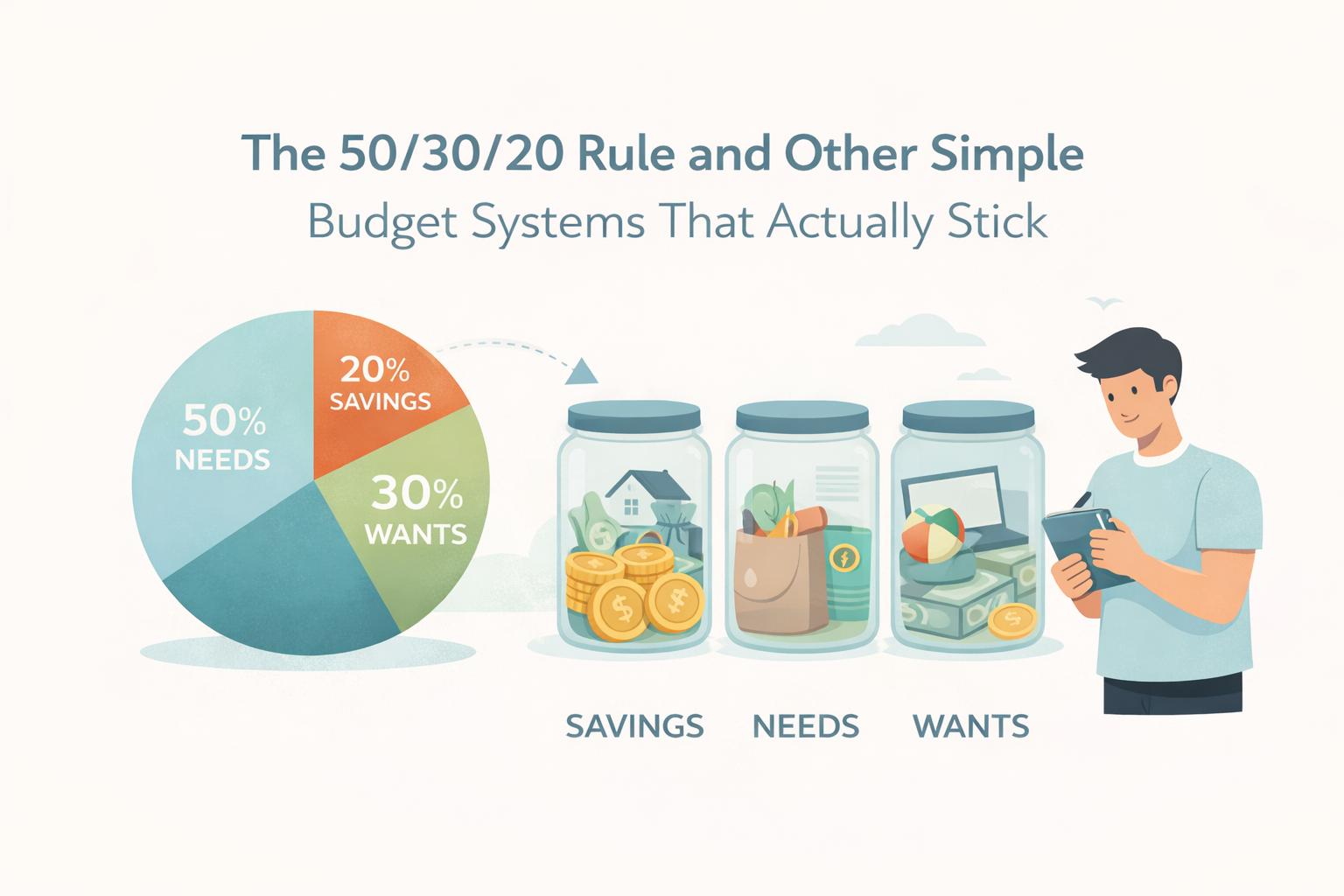
    The 50/30/20 rule says: As a starting framework, 50% of your take‑home income goes to needs, 30% to wants, and 20% to savings and investments. Needs are non‑negotiables like rent, basic groceries, mobile/Internet, essential transport, and minimum EMIs; wants are Zomato orders, weekend outings, travel, subscriptions, and impulse UPI spends. Savings and investments include your SIPs, RD/FD contributions, emergency fund, and extra loan prepayments.​

    In an Indian context, a ₹60,000 in‑hand salary might look like this: ₹30,000 for needs (₹18,000 rent/PG, ₹4,000 groceries, ₹3,000 transport, ₹5,000 EMIs and bills), ₹18,000 for wants (eating out, movies, trips, online shopping), and ₹12,000 for SIPs, RDs, and building a 6‑month emergency buffer. If your city is expensive and rent alone eats 40–50%, you can temporarily adjust to 60/20/20, but keep pushing needs down over time.​

    Zero‑Based Budgeting: Give Every Rupee a Job

    Zero‑based budgeting flips the usual “spend then see what’s left” approach. At the start of the month, you assign every rupee of your income a purpose—so Income – Expenses – Savings = 0 on paper. That does not mean you have zero in the bank; it means everything is pre‑decided: fixed bills, groceries, UPI pocket‑money, SIPs, even a “guilt‑free” fun category.​

    For example, if you take home ₹80,000, you might map it like this: ₹20,000 rent, ₹6,000 groceries, ₹4,000 utilities, ₹6,000 transport/fuel, ₹10,000 EMIs, ₹15,000 SIPs/investments, ₹5,000 emergency fund, ₹7,000 eating out and Swiggy, ₹4,000 shopping, ₹3,000 travel savings. When you hit the limit in a category—for instance, your UPI “eating out” envelope—you stop, not swipe another credit card. Apps and simple Excel sheets work well for this.​

    “Pay Yourself First”: Treat Savings Like a Mandatory Bill

    “Pay yourself first” means savings and investments go out before you start spending, not after you see what’s left. The moment your salary hits, you auto‑debit SIPs, recurring deposits, or transfers to a separate savings account, just like an EMI. Whatever remains is what you are allowed to spend on needs and wants.​

    In India, this can be as simple as: salary on the 1st, SIPs for mutual funds on the 3rd, RD on the 5th, and an automatic transfer to an “emergency fund” account. If you decide that 25% of your income is “pay yourself first,” then on ₹50,000 in‑hand, ₹12,500 leaves your main account automatically, and you learn to live on ₹37,500. Over time, these auto‑payments become invisible—your wealth grows in the background without daily willpower.​

    India‑Flavoured Examples: Rent, UPI, and SIPs in Practice

    A realistic structure for a 25‑ to 35‑year‑old in a metro could combine all three systems rather than choosing just one. You might use the 50/30/20 percentages as a rough guide, zero‑based budgeting to plan detailed categories, and “pay yourself first” to lock in SIPs and safety‑net savings. Rent and EMIs sit firmly in the “needs” bucket; UPI micro‑spends get their own “wants” sub‑category so you can see how much is vanishing into coffee and delivery; SIPs into equity funds, gold, or NPS form the backbone of the 20% saving/investing piece.​

    If your income is irregular (freelancing, commissions), you can still pick a base number—say the average of your last six months—and budget off that while sending any extra to a buffer or extra investments. 

    👉 The key is not perfection; it is choosing one system you can follow on a sleepy Monday night and sticking with it long enough for the results to show up in your bank balance.

    For questions, collaborations, or deeper guidance, write to us at info@nomisma.club 

    Disclaimer: This article is for educational purposes and not financial advice.