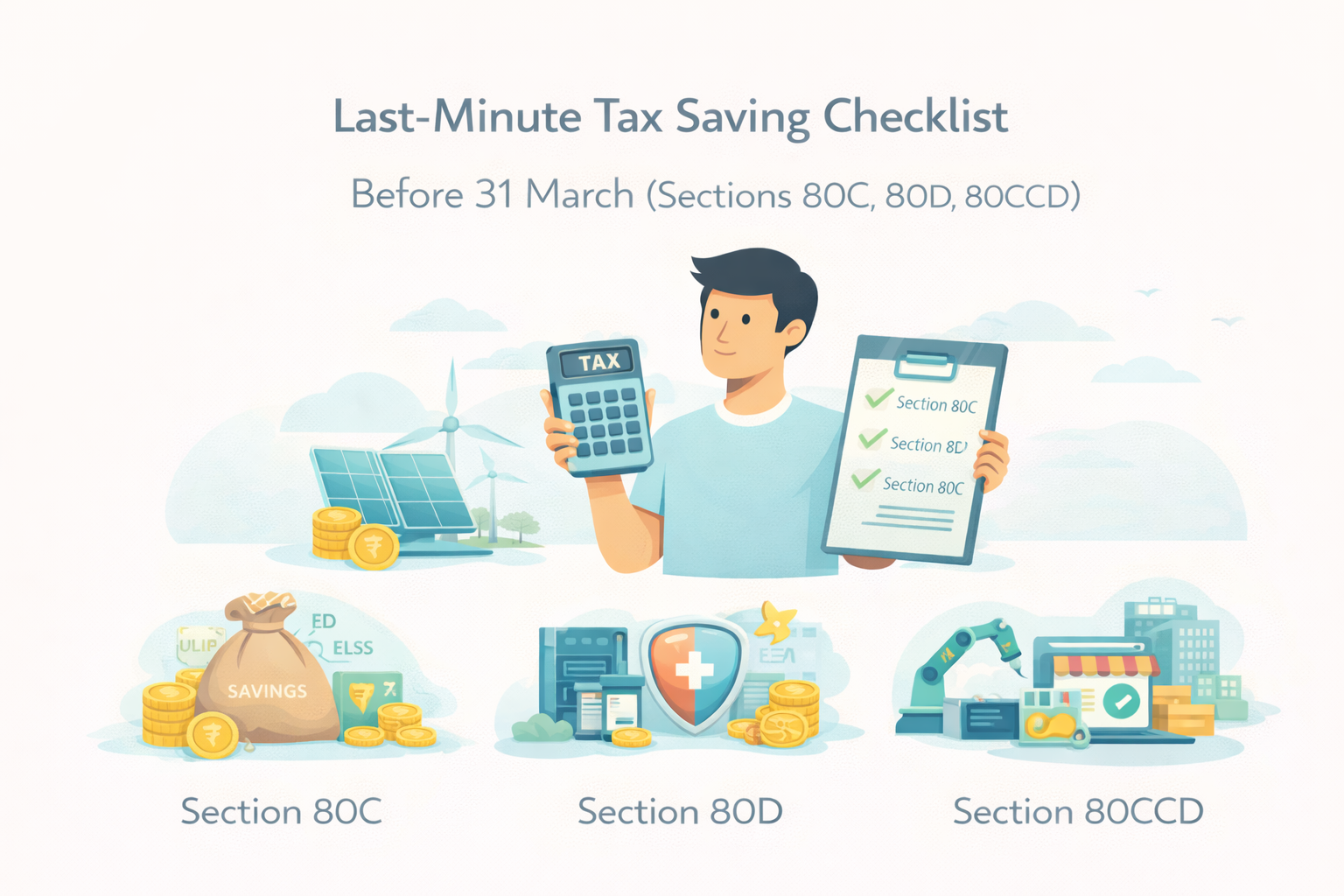
A last‑minute tax saving checklist works best when it tells you exactly which section to use, how much room is left, and where to park the next ₹10,000–₹50,000. This guide is for FY 2025‑26 (AY 2026‑27) under the old regime, where deductions matter most. Use this as a checklist, not a shopping list.
Step 1: Check if the Old Regime Even Makes Sense
Before chasing deductions, see whether the old regime actually beats the new one for your income and deductions.
- Old regime: higher slab rates but allows most deductions (80C, 80D, 80CCD, HRA, home loan interest under Section 24, etc.).
- New regime: lower slab rates, standard deduction, very limited deductions; suits people with few investments or benefits.
Use an ;old vs new regime’ calculator, plug in your expected 80C, 80D, 80CCD, and home‑loan claims; if the old regime shows lower total tax, this checklist is worth acting on.
Step 2: Maximise Section 80C (Limit ₹1,50,000)
The combined limit for the most common deductions here is ₹1,50,000.
Covered instruments include:
- Employee Provident Fund (EPF) and Voluntary PF
- Public Provident Fund (PPF)
- Equity‑Linked Savings Schemes (ELSS mutual funds)
- 5‑year tax‑saving bank fixed deposits
- Life insurance premiums (including term plans)
- Principal repayment of a home loan, tuition fees for up to two children
If you have ₹20,000–₹50,000 left under 80C:
- Up to ₹20,000 remaining, and you are comfortable with markets:
- Consider a lump sum into an ELSS fund or start a short series of monthly systematic investment plans before 31 March. Lock‑in is 3 years, and gains are taxed as long‑term capital gains. Expect short-term volatility; this suits money you won’t need for 3+ years.
- Around ₹50,000 remaining and you want safety:
- Top up your PPF if you already have an account (15‑year tenure, interest is tax‑free, and contributions count under 80C).
- Alternatively, use a 5‑year tax‑saving fixed deposit with a scheduled bank; interest is taxable, but the principal qualifies under 80C.
- If you have not bought term insurance yet:
- A pure term life policy premium also counts under 80C and simultaneously fixes a protection gap, which is often more important than squeezing another investment in.
Step 3: Use Section 80D for Health Insurance
Section 80D is specifically for medical insurance premiums and preventive health check‑ups.
Key limits for FY 2025‑26:
- Self, spouse, and dependent children: deduction up to ₹25,000 on health insurance premiums.
- Parents: additional up to ₹25,000 if they are below 60 years, or up to ₹50,000 if they are senior citizens (60 years or more).
What to do if you have remaining room under 80D:
- No health cover for parents, and you can spare ₹15,000–₹30,000, this year:
- Consider a family floater or senior citizen plan for them; this can both protect savings and reduce taxable income.
- Already have insurance but have not claimed a preventive health check‑up:
- A part of the 80D limit can be used for preventive check‑ups (within the overall cap), so a scheduled check‑up before 31 March can legitimately increase your claim.
Step 4: Add NPS on Top – Section 80CCD
The National Pension System has its own deduction structure and can sit on top of 80C.
There are three relevant parts:
- Section 80CCD(1): your own contribution, counted within the ₹1,50,000 limit of Section 80C (subject to 10% of salary for salaried employees).
- Section 80CCD(1B): an additional, exclusive deduction of up to ₹50,000 for your own NPS contribution, over and above the 80C limit.
- Section 80CCD(2): employer’s contribution to NPS (up to 10 percent of salary for private sector employees) is deductible for you and does not eat into the 80C limit.
If you still have room and time:
- If your 80C bucket is already full and you have another ₹20,000–₹50,000 to invest:
- A voluntary contribution to NPS Tier I to use the additional ₹50,000 limit under Section 80CCD(1B) is one of the clearest ways to reduce tax, plus earmark money for retirement.
- If your employer offers NPS and you are underusing it:
- You can discuss redirecting part of your cost‑to‑company into NPS so that Section 80CCD(2) benefits apply from the next financial year onwards. This is not a “last‑minute” step but is worth mentioning in a March‑time review.
Remember that NPS is a long‑term product; partial withdrawal and exit rules are stricter than those of mutual funds or PPF, so it suits people who are consciously building a retirement pool.
Step 5: Sequence if You Have Limited Surplus
If you are deciding where to allocate the next block of money before 31 March, a simple sequence many planners use under the old regime is:
- Close the 80C gap with instruments that match your risk and time horizon
- Growth‑oriented: ELSS mutual funds.
- Stability‑oriented: PPF or tax‑saving fixed deposits.
- Use 80D to fix any health insurance gaps for self and parents.
- Add NPS for an extra ₹50,000 deduction under Section 80CCD(1B) if you can genuinely lock this money away for retirement.
This way, each rupee just before year‑end either reduces tax, adds protection, or builds long‑term wealth rather than sitting idle in a low‑yield savings account.
For questions, collaborations, or deeper guidance, write to us at info@nomisma.club.
Disclaimer: This article is for educational purposes and not financial advice.
Leave a Reply