Why Passive Income Needs a Reality Check
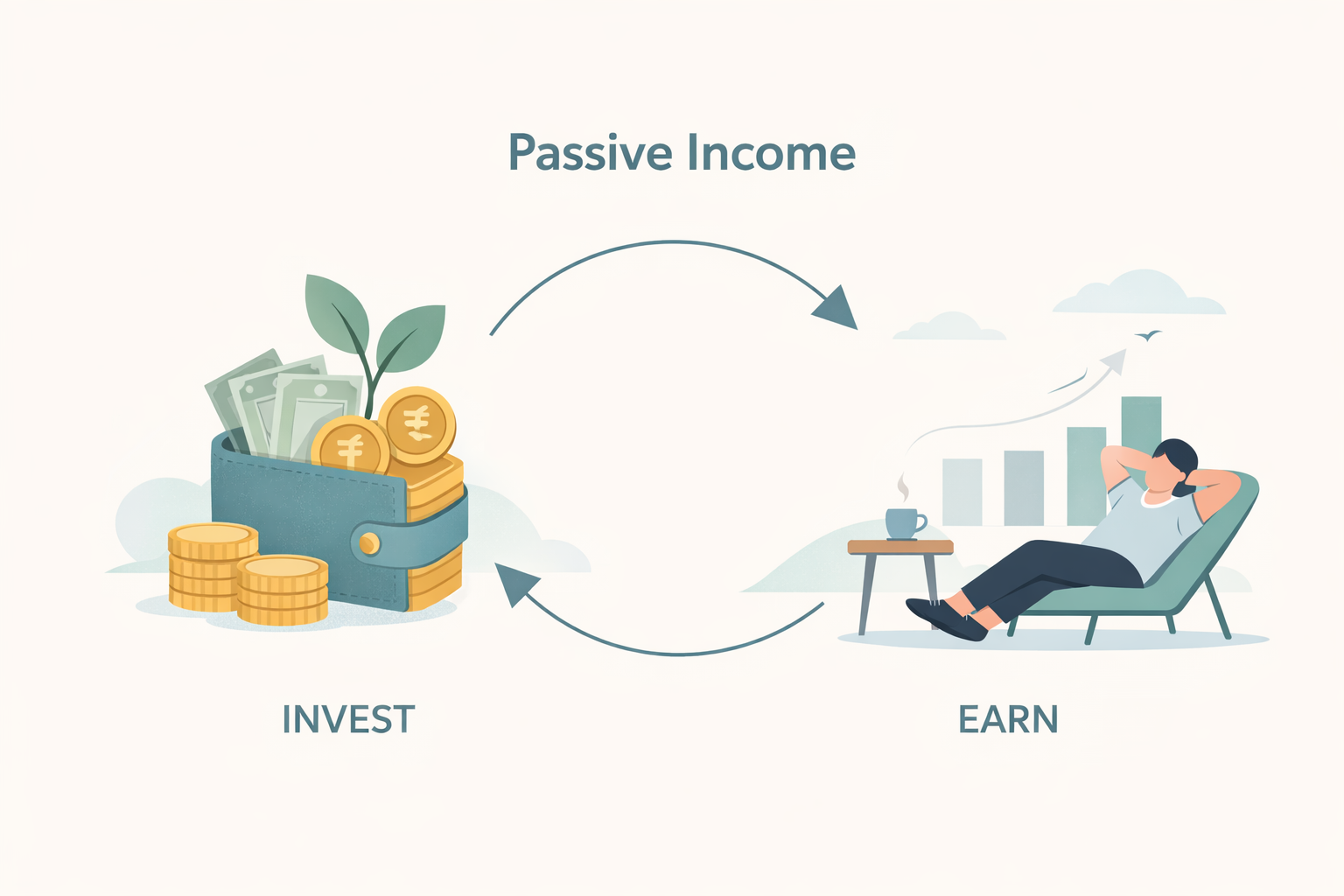
Passive income in India is less about “earn while you sleep” from day one and more about “build a system once, let it pay you for years.” It usually demands upfront time, skill, or capital, but the goal is to reduce how much you trade hours for rupees over time. This guide focuses on ideas that can realistically work in India in 2025, not lottery tickets or overnight riches.
Some of these ideas pay hundreds per month, others can scale into lakhs—but none are instant.
Low‑Effort Ideas (Money > Time)
1. Dividend‑Paying Stocks
Buying shares of solid, dividend‑paying companies can create a small but growing cash flow. When profits are shared as dividends, you get periodic payouts while still holding the stock for long‑term appreciation. Focus on stable businesses with a history of consistent dividends rather than chasing ultra‑high yields that may not be sustainable.
2. Debt Mutual Funds and Target Maturity Funds
Debt funds invest in bonds and money‑market instruments and can offer better post‑tax returns than traditional bank FDs if held for the right period. Target maturity funds (which invest in government and high‑grade bonds to a fixed maturity year) give more visibility on expected yield and reduce reinvestment risk. These work best for investors seeking relatively lower volatility with some inflation-beating potential. Returns depend on interest rate cycles and holding till maturity.
3. REITs (Real Estate Investment Trusts)
REITs let you earn rental‑like income from Grade‑A commercial properties without buying an office or shop outright. Units trade on stock exchanges and typically distribute a large chunk of their income as dividends or interest. They add real‑estate exposure with lower ticket size and better liquidity than owning a physical property.
4. High‑Interest Savings and Sweep‑In Accounts
Some banks and small finance banks offer higher interest on savings or sweep‑in FDs while still letting you access funds quickly. Setting up automatic sweeps (where surplus from your savings account is moved into FDs above a threshold) ensures idle cash earns something without manual intervention. It is not glamorous, but it is a simple way to make your emergency fund work slightly harder.
5. Cashbacks, Rewards, and Co‑Branded Cards
Used smartly, credit cards and reward programs can become a small passive stream in the form of points, miles, and cashbacks. Paying all bills through one or two cards and clearing dues in full avoids interest while maximizing rewards. This is not a primary income source, but over a year the value can materially reduce your travel or shopping costs.
If you can invest some time upfront, the next set of ideas opens up higher upside.
Medium‑Effort Ideas (Some Work, Ongoing Payouts)
6. Rental Income from a Room or Parking Space
Instead of buying an entire rental property, many people start by renting a spare bedroom, storage space, or even a dedicated parking slot. This drastically reduces capital needed compared to a full flat purchase. Once a tenant is found and rules are clear in writing, the income is relatively steady with occasional management effort.
7. Recurring Digital Products (Templates, E‑Books, Planners)
Creating a digital asset once and selling it repeatedly is a classic semi‑passive play. Think budget planners, tax checklists, niche e‑books, or Excel templates for freelancers and small business owners. Distribution can be handled through marketplaces or your own site, and once the product is built, updates are occasional rather than constant.
8. YouTube, Reels, and Content Monetization
Short‑form and long‑form content around finance, careers, or niche hobbies can generate ad revenue, brand deals, and affiliate commissions. The “passive” part comes once older videos keep getting views and paying months later. The upfront grind is real—scripting, editing, and consistency—but the compounding effect of a content library is powerful. This pairs well with affiliate marketing, where older content continues to convert.
9. Affiliate Marketing and Recommendation Blogs
Running a blog or simple website that recommends tools, apps, books, or financial products lets you earn a commission when readers sign up or buy. It fits especially well with money, travel, and tech content, where people actively search for “best” options. Once articles rank and get organic traffic, they can bring in income with only periodic updates.
10. Royalty‑Style Income from Courses
If you have deep expertise—say in tax filing, freelancing, or exam prep—packaging it into a structured course can generate repeated sales. Platforms that handle hosting, payments, and delivery reduce technical friction. After the initial build and a push to get reviews, a well‑positioned course can continue selling with light promotion.
High‑Setup Ideas (Capital or Significant Build‑Out)
11. Traditional Rental Real Estate
Buying a residential property purely for rental income is capital‑heavy but can offer a combination of rent plus long‑term appreciation. True passivity demands doing the groundwork: choosing locations with good demand, screening tenants carefully, and having clear agreements. Net yield after maintenance, vacancy, and tax is what matters—not just the headline rent.
12. Fractional Real Estate and Co‑Investment Platforms
Instead of buying an entire office or warehouse, some investors participate in fractional ownership arrangements. Multiple investors co‑own a commercial property and share rental income proportionally. This reduces ticket size but requires due diligence on platform credibility, legal structure, and exit options.
13. Peer‑to‑Peer (P2P) Lending
P2P platforms allow you to lend small amounts to many borrowers, earning interest over time. Diversification across multiple loans is critical to reduce default risk. This can feel passive once your rules and auto‑invest settings are configured, but it is inherently higher risk than traditional bank deposits. Limit exposure to a small percentage of your overall portfolio.
14. App‑ or Tool‑Based Micro‑Businesses
Building a small app, plugin, or SaaS tool that solves a narrow problem—like invoicing, content planning, or Indian tax calculations—can generate subscription or one‑time sale income. The upfront build is intensive, but maintenance can be modest if the scope is tightly defined. Over time, existing users and word of mouth can turn it into a low‑touch revenue stream.
15. Licensing Your Work or IP
Photographers, designers, writers, and coders can license their creations rather than selling them once. Stock photos, UI kits, code snippets, or even background music can be licensed through marketplaces. The key is building a high‑quality, searchable catalogue that keeps selling long after the original effort.
How to Choose the Right Idea for You
- Capital vs time trade‑off: If you are early in your career with limited savings, focus on content and digital products; if you have surplus capital, lean into financial instruments and real estate exposure.
- Risk comfort: Debt funds, REITs, and high‑interest accounts sit on the lower‑risk side; P2P lending, individual dividend stocks, and fractional properties need a stronger risk appetite.
- Skill leverage: Play where you already have an edge—writing, coding, teaching, design, or real‑estate knowledge—so you are not starting from zero on both skills and systems.
👉Start with one idea, get it working, and only then layer on the next.
Seen this way, “passive income” is less a single hack and more a portfolio of cash flows that slowly decouple your lifestyle from your monthly salary.
Passive income is a portfolio, not a shortcut.
For questions, collaborations, or deeper guidance, write to us at info@nomisma.club
Disclaimer: This article is for educational purposes and not financial advice.
Leave a Reply