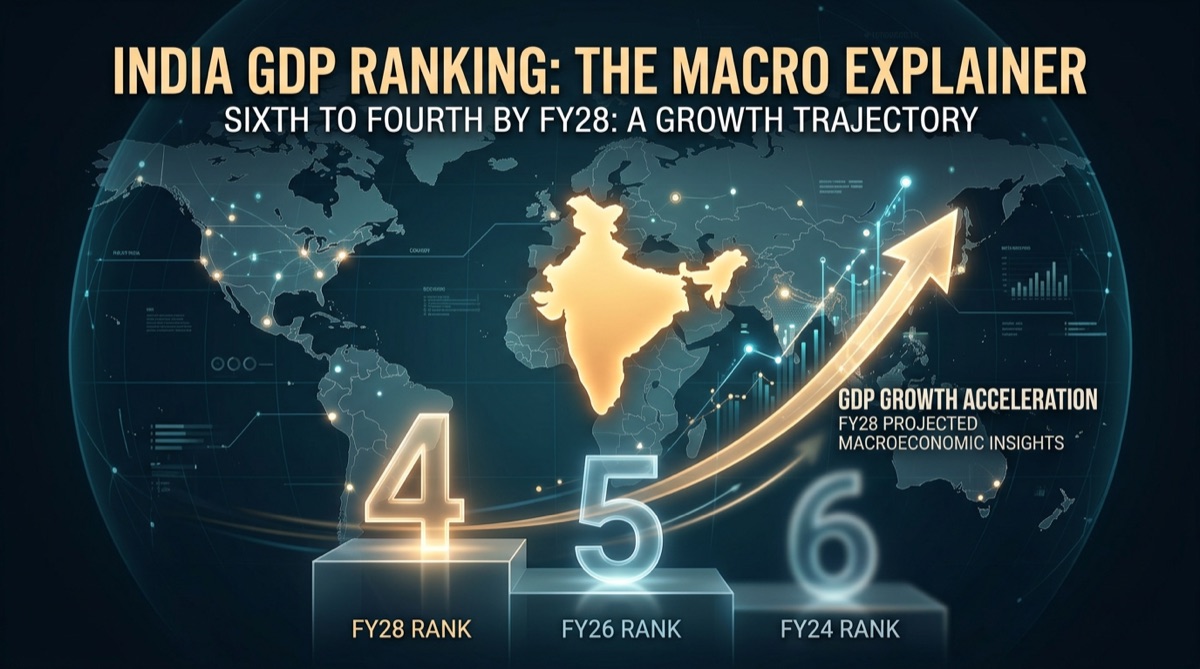
Headlines that say India will move from the sixth largest economy to the fourth by FY28 usually mix nominal USD GDP, FX rates, and forecast revisions from multilateral institutions. For equity investors, the useful question is not the rank number but what drives per-capita prosperity and corporate earnings quality.
Nominal vs PPP rankings
Nominal GDP in USD jumps when the rupee is stable or strong vs the dollar and when inflation lifts local nominal output. Purchasing power parity (PPP) rankings adjust for local prices—India often ranks higher on PPP than nominal tables. Rank-chasing without the denominator is empty.
Revision risk in forecasts
IMF/World Bank/MOSPI all revise GDP paths after shocks (oil, war, domestic credit cycles). A FY28 rank is a model output, not destiny.
What equity markets care about
- Earnings breadth beyond a few index names.
- Real rates and capex cycles.
- Policy predictability in infrastructure and licensing.
Bridge to IT exports narrative
GDP composition still leans on services exports; global AI capex shifts matter for Indian IT—read Anthropic-style model releases and Indian IT at sector level.
Official data habit
Prefer MOSPI national accounts releases over social infographics for baseline facts.
Bottom line
Celebrate rank improvements as directional validation of growth, not as a reason to YOLO index calls. Per-capita metrics and inequality remain the honest stress test.
Educational only—not investment, legal, or tax advice.
Leave a Reply